
Contest
my brother would have loved this photo

Something different. An experiment. A competition.
Scott vs. A.I.
Stories. Tell a story. Write a (very) short story. And then… ask a few A.I. models to write a similar story.
Compare. Contrast. (Let’s see what happens. What does that look like?)
<><><><><>
Input, the assignment:
Write a very short story (approximately 350 words) about an early summer day, a ten-year-old boy with a butterfly net, outside, playing on a hill behind his house, alone.
What does the boy do? What does he see? Describe his experience.
What does he see, touch and feel?
<><><><><>
Scott writes a story: Scott Intelligence (S.I., or whatever that is in my head)
I was ten years old, home early from a half day of school. My best friend was away with his family, off somewhere; doing something. My bestie friend, not available. I had totally free time; no inputs but my own. One hundred percent - MY Time.
I had a big fine mesh net, mounted onto a long pole. My Dad made it for me. An insect catching net. The slope, we called it “the hill” behind the house that I grew up in was full of mostly natural vegetation (i.e. - weeds and wild scrub) mixed with some medium height wispy needle pine trees that were planted by my Dad and other neighborhood men, sometime in the past; sometime before I was born.
On a bright, warm, a few happy clouds in the sky, no chance of rain - 100% my time day, I decided to Bungalow Bill (a Beatles song) run in the field, with my net, try to catch wild things, to give to my older brother (to add to his carefully preserved pinned and mounted and biologically named - collection; local insects mounted on boards in the name of science).
I saw a butterfly, a short distance away, pretty yellow markings on its wings. I imagined myself an Explorer, jungles of Africa, my feet running across land never touched by a man. My net in one hand, my other arm swinging in the warm breeze, pushing shrub branches and tall weeds aside.
“Make way for Bungalow Bill.”
I swing my net as the yellow wing butterfly lifts off from a flowering weed. Three-point shot, all net, the Wild Kingdom (it was a weekly TV show) crowd cheers. Scott scores. Yellow wing butterfly in the net. (Bagged and tagged.)
A prize, a gift - to share with my brother. But then…
I look closely at the captured wild creature. It’s struggling to flap its wings. To fly again and forage; to do - what it was born to do.
I feel pity, empathy - yes, for an insect, a fellow creature, a fellow creation.
I open my net. I let “my prize” go. Fly again. Fly away. Be free.
Scott, young Scott. A summer day. A boy in a field with a net.
<><><><><>
I’m not sure how well I followed my own assignment. One thing, it’s mostly autobiographical. My story is - - - mostly true.
Everything but the “letting the butterfly go and be free again part” of my story, I remember these things.
I don’t specifically remember letting insects go or keeping them. I suspect I did - both. Both (little boy) choices were likely - true.
I suspect and do seem to recall that not a small number of small creatures were injured in the process of capture. A sad truth of “the game”.
<><><><><>
OK, your turn A.I.
Let’s see what you got.
AI Written Story - Program One:
A warm early‑summer morning lifts around him as the ten‑year‑old boy climbs the grassy hill behind his house, his butterfly net bouncing lightly against his shoulder. The hill is still damp from last night’s rain, and each step releases the sharp, green scent of crushed stems. He likes that smell. It makes him feel like the world is waking up with him.
At the top, sunlight spills over everything—wide, bright, and a little too golden, the way early summer light always is. He squints, then grins. The whole hill feels like it belongs to him.
A flicker of movement catches his eye. A swallowtail drifts low over the clover patches, its wings tilting like tiny sails. He holds his breath, creeping forward. The net trembles in his hands; he can feel the wooden handle warming in the sun. When he swings, he misses, but the butterfly spirals upward, scattering specks of yellow light. He laughs anyway. The chase is the best part.
He wanders. He touches everything. The rough bark of the lone oak tree. The cool, smooth stones half‑buried in the dirt. The fuzzy tops of foxtail grass that tickle his palms. A ladybug crawls across his knuckle, its tiny feet tapping like whispers. He watches it lift its wings and vanish into the bright air.
Down the slope, the wind shifts. It brushes his cheeks, warm at first, then cooler as it sweeps across the open field. He closes his eyes and lets it push against him, imagining he might lift off the ground like the butterflies he chases.
When he opens them again, the world looks bigger—sky stretching forever, clouds drifting like slow ships, the roofs of his neighborhood tiny and far away. He feels small, but not in a bad way. More like he’s part of something huge and alive.
He takes one more swing at a darting flash of blue. Misses again. Doesn’t mind. The hill is his kingdom, the morning his adventure, and the summer—just beginning.
<><><><><>
AI Written Story - Program Two:
a little better, but very similar to AI Written Story One (I think)
The day had tilted warm and golden, the kind of early summer that smells like cut grass and sunlight. He carried the butterfly net like a flag—its handle warm from the sun, the mesh soft and whispery. Ten years old, knees already scabbed from other small adventures, he climbed the hill behind his house where the world felt bigger and quieter all at once.
At the top, he paused. The slope opened into a patchwork of wildflowers: white Queen Anne’s lace, fat blue cornflowers, and dandelions gone to puffy, waiting. A thin breeze moved through, and the whole meadow rippled like a green ocean. He could hear the distant hum of a lawnmower down the street, a dog barking somewhere, but up here the sounds were smaller—bee wings, the rustle of grass, the occasional creak of the net when he shifted it.
He walked slowly, barefoot, the earth warm and slightly damp from a morning sprinkle. The soles of his feet tickled at first, then settled into the familiar map of the hill—stones that pressed into the tender pads, soft clods that gave under his weight. He reached out and let his fingers brush the tall grass; it slid between them like silk, sticky with pollen, dusting his skin yellow. He laughed softly when a cluster of mint brushed his wrist and left a cool, sweet scent.
A swallow swooped low, then higher, painting an arc above his head. He raised the net on instinct, following a flurry of silver wings—tiny moths, then a bold monarch that hung in the air for a breath, orange and black like a bit of flame. He crouched, careful, the world narrowing to the butterfly’s slow wingbeats and the net’s rim. The monarch landed on a thistle, wing-tips trembling. He didn’t catch it. He watched instead, thrilled by the closeness, the fragile tremor of life balanced on a purple bloom.
Sun warmed his neck; a bead of sweat traced down and cooled as the wind kissed it away. He closed his eyes for a second and kept them shut just long enough to hold the sound of the hill—the high white noise of insects, the soft creak of the net, his own breathing—like a secret. When he opened them, the meadow spread out, bright and patient, as if waiting for him to come back tomorrow. He tucked the net under his arm and ran home down the slope, the hill’s small world tucked behind him like a treasured thing.
AI Written Story - Program Three:
IMO, the best of the three
The tall grass of early summer always felt like a secret ocean, and ten-year-old Leo was its sole explorer. Cresting the massive hill behind his house, he let out a breath he didn’t realize he’d been holding. The world down there—with its schedules and chores—faded away. Up here, there was only the wind and the wide, blue sky.
In his right hand, Leo gripped the smooth, weathered wooden handle of his butterfly net. The white mesh pocket trailed behind him like a kite tail. He wasn’t actually out to harm anything; the net was just his excuse to chase the wind.
The morning sun was already warm, baking the earth and releasing the sweet, sharp scent of wild chamomile. Underfoot, the dry dirt of the hillside trail crunched rhythmically. A sudden breeze swept up the slope, cooling the sweat on the back of his neck and sending ripples through the golden mustard weeds.
That’s when he saw it: a flash of brilliant, electric blue.
It wasn’t a common Monarch or a pale cabbage butterfly. It was a Pipevine Swallowtail, its iridescent wings catching the light like a gemstone. It bobbed lazily just above a patch of thistle, seemingly unaware of him.
Leo froze. His heart hammered against his ribs—a frantic, excited thumping. He crept forward, his bare ankles brushing against the prickly weeds. He could feel the sun-warmed dust settling between his toes.
He raised the net, balancing on one foot. The butterfly dipped. Leo lunged, sweeping the net through the air with a soft whoosh.
He missed.
The Swallowtail spiraled upward, dancing just out of reach before fluttering away toward the tree line. Leo didn’t mind. He dropped into the thick grass, laughing out loud to no one. He rolled onto his back, pressing his palms into the cool earth beneath the top layer of dry soil. High above, a hawk coasted on a thermal. Leo closed his eyes, listening to the buzz of cicadas, perfectly content in his own private wilderness.
<><><><><>
I think that the third AI Written story is the best for two reasons:
One, like my Human Intelligence story, AI Program Three gave the human character in the story - a name. Giving the boy in the story a name, adds depth and reader connection to the story.
I like the name to fit the story - boy with butterfly net. I like the AI chosen name - Leo.
Short name, simple, easy to remember and pronounce; sounds like a “boy in nature” name - Leo.
I used my own name. Scott, not exactly a “boy in nature” name. Feeding ego perhaps, rather than working in the best interest of the story?
But the reason why I feel like my story wins the contest. Human Intelligence wins over the artificial kind; well - I think that my story, it rings true. Even if we were aiming for fiction, the best fiction “reads” true.
AI can simulate truth, but never get there, never arrive at authentic - truth.
But moreover, I think my ending “seals the deal”.
In my story, the boy does catch the butterfly and most importantly, something the AI can also never have - it’s heart and soul.
Boy catches butterfly, feeling compassion and empathy, the boy (truth or not), the boy in my story, he lets the butterfly go.
The AI stories remind me of too many Netflix productions. Stories full of filler, all bread and not enough meat. Stories designed to fill empty time.
Like a “talking bird” in a cage, AI can mimic us. Artificial Intelligence can never replace us.
AI, you are (just) a tool.
You and me, you and me - brothers and sisters - we cannot be replaced.
We are the real deal.
We will survive because we are The Real Thing.
Real sentients, more than a collection of programming ones and zeros.
Authenticity writes the rules. Authenticity will always rule.
Master the new tools as they come along. (Don’t let the tool be the master of authentic YOU. Don’t lean on your tools too hard.)
Use the tools, use them well, and don’t worry about it.
The ones who use the tools, and maintain their heart and soul,
They will not be replaced.
They will always win.
Authentic YOU + new tools = Win, win.
<><><><><>
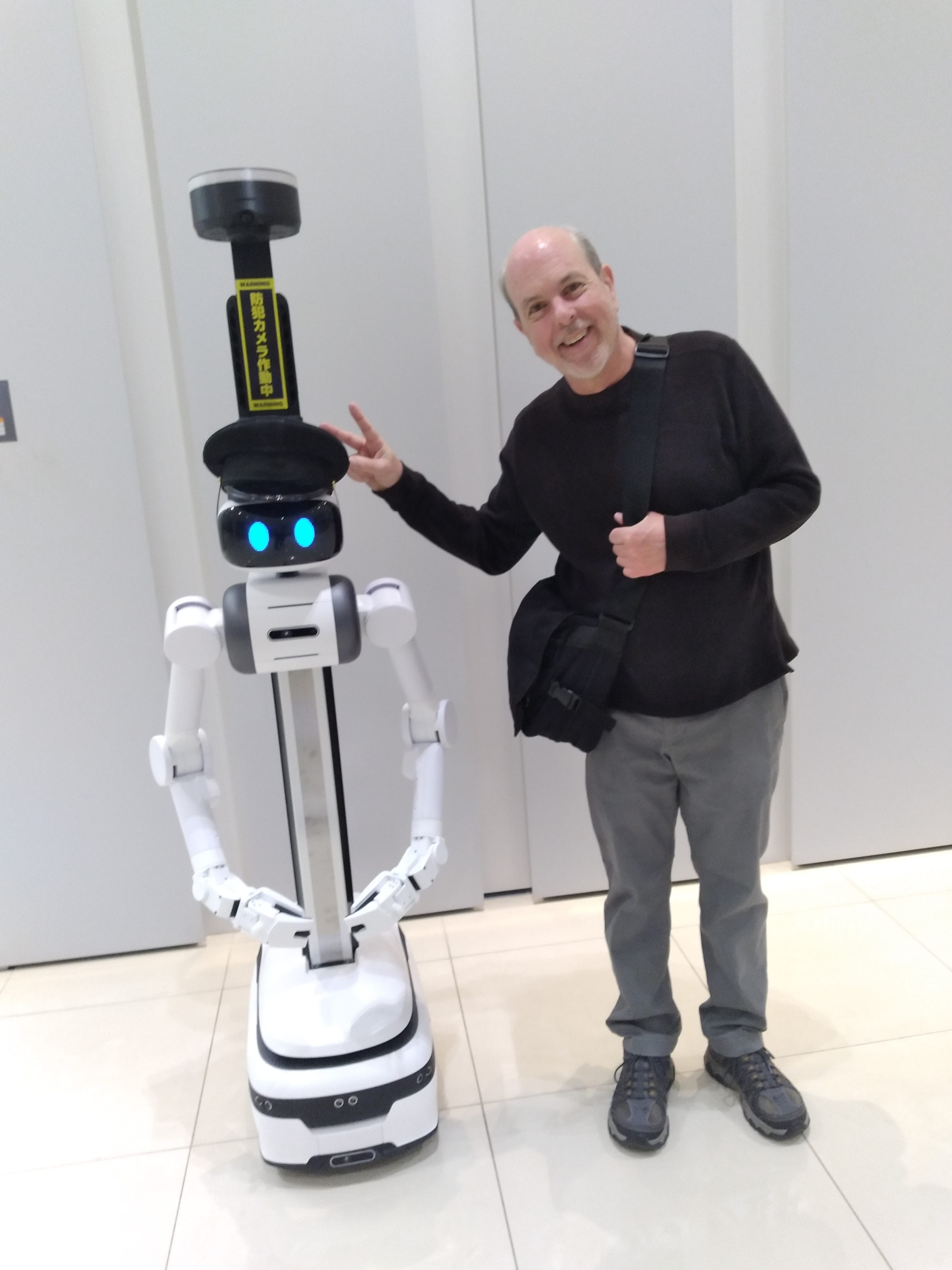
PHOTO:
Top of a tall building, a crazy big, nice, bustling departments store - Osaka, Japan
A lookout floor, see all the tall buildings in Osaka.
That’s me and a Police Robot. (A human Policeman was off to the side, gave us the OK to take pictures.)
I talked to the Robot. I asked it a question. Something like, “how are you today?”
Nothing, I got nothing. The nuts and bolts just stood there, looking straight ahead. No response, no reply.
Don’t worry friends. We will not be replaced.
Us kids, you and me, we’re OK. We’re going to be - just fine.
Wit and wisdom - I wonder if these can be simulated. Also the pause, the moment to consider, the second of indecision - perhaps AI can be asked to include something like this, but I'm not sure if it would work. I like your experiment. Thanks for sharing it. I like the tool and I think I would use it to help me with style... perhaps steal a few sentences here and there from the AI mind.